A non-fan writes...
So, J.K. Rowling has a new book out. As someone who hasn't read a single page of Harry Potter's long and - to millions of people - inspiring adventures, I'm not wildly excited and probably won't read it. But I can grasp that a popular writer changing direction and producing a book that's definitely not for younger children (but which teens will probably read) is news.
Rowling is left-liberal in her politics, which explains why the right-wing press - almost a tautology, nowadays - has gone after her. Much of the negative coverage about her manner at interviews seems sexist. All I heard in a BBC radio interview this week was an intelligent woman talking in a way that, in a male author, would have been described as forthright, trenchant, or confident.
Regardless of how Rowling talks to hacks (many of whom are not especially likeable or trustworthy people, I feel) it's worth remembering that, unlike most rich authors, she has put her huge fortune to charitable use. And here's something that someone tweeted at me (and a few thousand others).
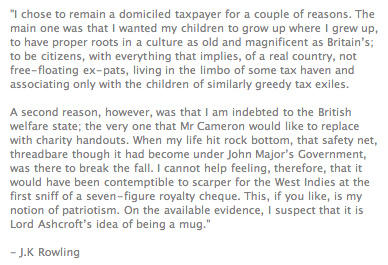
I like that. But it's another Twitter comment that set me off. I assume it's a quote from a newspaper interview or something equally ephemeral.
"..& you have achieved a net worth of £560 million, often from the pocket and birthday money of children.."
Of course, back in the 1860s it was commonplace to remark: 'Mr Dickens, you have achieved a net worth of £34,412, 14s & 5p, often from the small-beer money of the Great Unwashed!' Or maybe not.
But the implication is clear enough - that when an author achieves stellar success it is somehow morally wrong to keep making more money. Beyond a certain point (A million pounds in the bank? Ten million?) writers should stop charging and give the stuff away free - that, I think, is the implication of the crack.
Nobody expressed the same opinion with regard to the late Steve Jobs - that the cost of an iPad could have been reduced, as Mr Jobs was rich enough to sell them at cost without feeling it. Absurd, isn't it? Steve Jobs was a real businessman in the real world - one who made a healthy profit for his shareholders, employed lots of people, and accumulated great wealth for himself, right down the line. By contrast, most professional writers don't get paid more than a few thousand a year, and they tend to have a 'real' job to get by.
A lucky few, like Rowling, achieve what the world calls great success. Most writers never do. And it's all a bit of a lottery, because everyone can think of at least one author - living or dead - who deserves greater recognition. And that's part of the problem, too - success being a matter of luck as much as skill. Because another game the media, with public connivance, like to play is The Undeserving Lottery Winner.
Anyway, here's a nice, thoughtful item about Rowling's new book, which points out that she's done some good for people with a real but often trivialised condition.
Rowling is left-liberal in her politics, which explains why the right-wing press - almost a tautology, nowadays - has gone after her. Much of the negative coverage about her manner at interviews seems sexist. All I heard in a BBC radio interview this week was an intelligent woman talking in a way that, in a male author, would have been described as forthright, trenchant, or confident.
Regardless of how Rowling talks to hacks (many of whom are not especially likeable or trustworthy people, I feel) it's worth remembering that, unlike most rich authors, she has put her huge fortune to charitable use. And here's something that someone tweeted at me (and a few thousand others).
I like that. But it's another Twitter comment that set me off. I assume it's a quote from a newspaper interview or something equally ephemeral.
"..& you have achieved a net worth of £560 million, often from the pocket and birthday money of children.."
Of course, back in the 1860s it was commonplace to remark: 'Mr Dickens, you have achieved a net worth of £34,412, 14s & 5p, often from the small-beer money of the Great Unwashed!' Or maybe not.
But the implication is clear enough - that when an author achieves stellar success it is somehow morally wrong to keep making more money. Beyond a certain point (A million pounds in the bank? Ten million?) writers should stop charging and give the stuff away free - that, I think, is the implication of the crack.
Nobody expressed the same opinion with regard to the late Steve Jobs - that the cost of an iPad could have been reduced, as Mr Jobs was rich enough to sell them at cost without feeling it. Absurd, isn't it? Steve Jobs was a real businessman in the real world - one who made a healthy profit for his shareholders, employed lots of people, and accumulated great wealth for himself, right down the line. By contrast, most professional writers don't get paid more than a few thousand a year, and they tend to have a 'real' job to get by.
A lucky few, like Rowling, achieve what the world calls great success. Most writers never do. And it's all a bit of a lottery, because everyone can think of at least one author - living or dead - who deserves greater recognition. And that's part of the problem, too - success being a matter of luck as much as skill. Because another game the media, with public connivance, like to play is The Undeserving Lottery Winner.
Anyway, here's a nice, thoughtful item about Rowling's new book, which points out that she's done some good for people with a real but often trivialised condition.


Comments
Her comments above remind me of Stephen King's "Tax Me For Fuck's Sake!" article:
http://www.thedailybeast.com/articles/2012/04/30/stephen-king-tax-me-for-f-s-sake.html